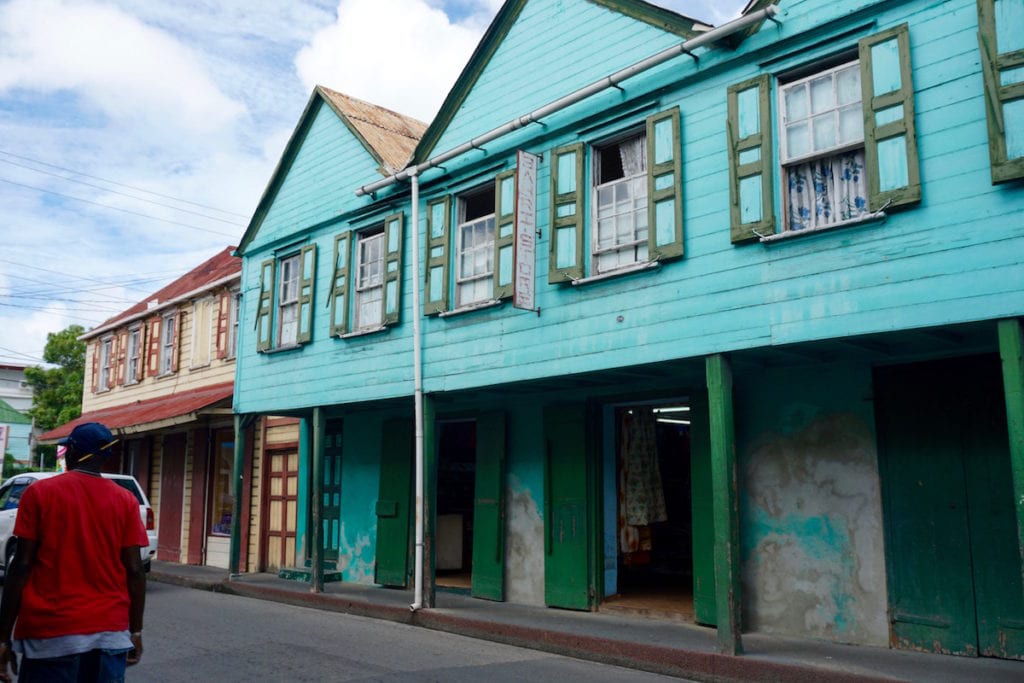
Traditional wooden architecture in St John’s, illustrating the type of older timber construction historically associated with the capital.
Booby Alley to Pelican Court: The Remaking of a Historic St John’s Community
(This is entirely written by CHAT GPT)
For generations, Booby Alley was one of the poorest and most densely settled parts of The Point. But it was also a place with deep ties to Antigua’s working-class, political and cultural history. Today the old settlement has disappeared, 150 new condominiums are rising in its place, and the surrounding waterfront is being transformed by hundreds of millions of dollars in port and tourism investment.
Booby Alley was more than a collection of ageing wooden houses waiting to be redeveloped. It occupied a small, low-lying part of The Point, immediately north of central St John’s, in an area that has long been associated with some of the city’s poorest residents. Its history, however, reaches much further back than the modern housing debate.
A place with a difficult beginning — and an important history
In a historical account published by the Historical & Archaeological Society of Antigua & Barbuda, H.D. Anderson O’Marde, then a Field Research Officer in the Ministry of Culture, described the lower Point area as having once been used as a cemetery during periods when yellow fever was devastating Antigua. He identified the old burial area as lying between Wilkinson Cross Street, Mariner’s Lane, Dickenson Bay Street and North Street.
According to O’Marde’s account, the area later became a dense residential settlement occupied largely by poor Black Antiguans, including descendants of enslaved people. Houses were packed tightly together and connected by a maze of narrow lanes and alleys. The physical conditions may have been poor, but the community developed a significance far beyond its small size.
O’Marde linked the area to the 1918 labour disturbances, to the emergence of organised labour, and to traditions that helped preserve African-Antiguan cultural expression. He also identified Booby Alley with traditions including Monkey Band, moko jumbie and African drumming.
The important historical point is that Booby Alley can fairly be described as a poor and neglected community, but that description is incomplete. It was also part of the social base from which important working-class, labour and cultural movements emerged in Antigua.
Who lived there?
Precise census statistics for Booby Alley alone are difficult to isolate because official statistics are generally organised into larger enumeration areas. Contemporary accounts nevertheless give a reasonably clear picture of the community.
Published descriptions have put the old settlement at roughly 3½ acres, containing more than 100 chattel properties. Government and media accounts have referred to roughly 105 families at various stages of the redevelopment process.
The community was predominantly working-class and economically vulnerable. Government itself repeatedly described housing conditions as substandard. Some dwellings reportedly lacked modern toilet facilities, while overcrowding, drainage and wastewater disposal were longstanding problems.
That does not mean the neighbourhood was socially uniform. As with many old Caribbean urban communities, residents included property owners, occupants of chattel houses, tenants, extended families, small business operators and people occupying property under different arrangements.
The decision to clear Booby Alley
The modern redevelopment programme began years before construction of the present condominium complex. Government proposed removing the old housing stock and temporarily relocating residents so that the site could be cleared and rebuilt.
The process was controversial. Some residents protested amid fears that they would lose their homes or be permanently displaced. Government maintained that existing residents would be accommodated in the new development and began constructing and sourcing temporary housing, including units on Bay Street.
The 2020 Budget also recorded compulsory acquisition involving 25 Booby Alley parcels, valued at approximately EC$993,386, as part of the broader relocation and redevelopment process.
By March 2021, the first group of families had received keys to temporary homes. Other residents were placed in rented accommodation, while some chattel houses considered sufficiently sound were reportedly relocated to other plots.
The clearance was not entirely consensual. Some residents resisted leaving. By 2023, Parliament was preparing to compulsorily acquire one of the remaining properties, although an agreement was ultimately reported to have been reached.
By October 2023, the remaining houses had been removed and the site had essentially been cleared.
China, 150 condominiums and the birth of Pelican Court
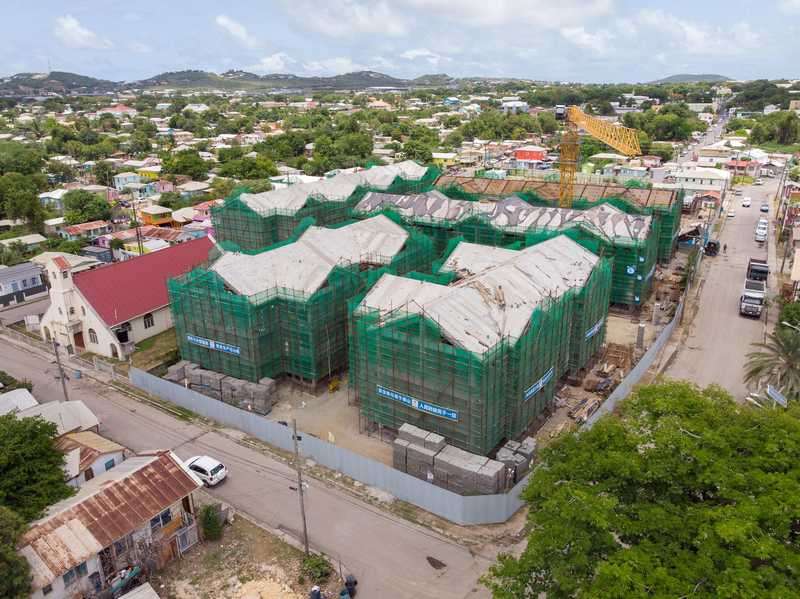
Construction of the new Booby Alley/Pelican Court housing development in The Point.
The replacement development is being financed through a major grant from the People’s Republic of China.
Published figures have varied depending on the year and whether officials were referring to the Booby Alley phase alone or the larger Chinese-supported housing programme. The 2025 Budget Statement put the Booby Alley Housing Development at approximately EC$60 million, while other public statements have cited considerably higher figures when associated works and programmes are included.
The development now comprises 150 condominium-style homes. Government describes them as modern, climate-resilient housing with substantially improved infrastructure.
Former property owners are expected to receive priority. Prime Minister Gaston Browne has indicated that former owners may receive replacement apartments through a swap arrangement. Remaining apartments are expected to be allocated primarily through mortgages or other structured forms of ownership.
The old name is also disappearing. Browne has suggested Pelican Court as the name of the new community.
A very different kind of community
What is being planned for Pelican Court differs significantly from the relatively informal community that existed there before.
In August 2026, Browne said the development could include two resident property managers, an administrative office, formal rules governing maintenance and resident behaviour and potentially a permanent police outpost staffed by two officers at a time.
The Prime Minister has also raised the prospect of a community or property-management charge to pay for common expenses. Those expenses could include maintenance of shared areas and infrastructure such as sewage and wastewater systems.
Browne even suggested that such fees might ultimately be collected through utility bills because homeowner associations at some previous government developments have had difficulty collecting maintenance contributions.
The result is therefore not simply a change from wooden houses to concrete condominiums. It is a shift from a historically informal, densely connected neighbourhood to a formally managed residential complex with rules, fees, managers and potentially a permanent police presence.
The cruise-port transformation next door
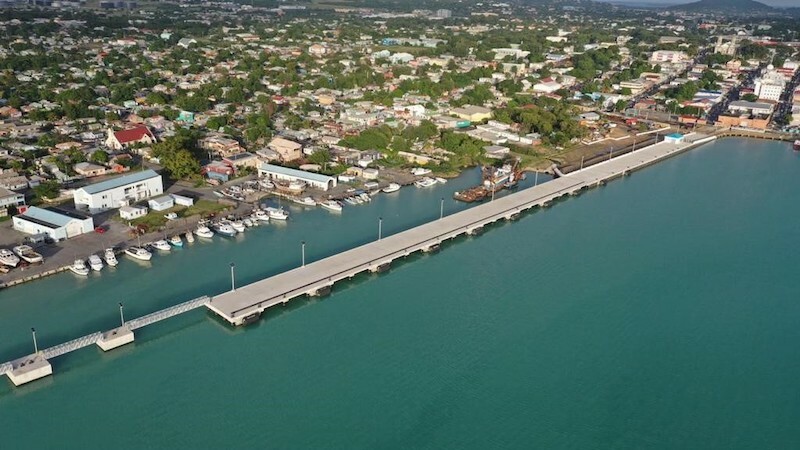
The fifth cruise berth at St John’s. The adjoining waterfront and upland area form part of the much larger transformation of the harbour edge.
Pelican Court cannot be viewed entirely in isolation from what is happening along the neighbouring shoreline.
The St John’s cruise-port redevelopment has transformed the western waterfront of the capital. An environmental study prepared for the St John’s redevelopment describes the fifth berth, completed in 2020, and identifies approximately 20,000 square metres of land behind the pier for further development.
The same environmental study describes the surrounding district as a mixed residential and commercial area containing private homes, shops, bars, restaurants and other businesses. It also records that properties surrounding the development had been acquired and that much of the project land had been cleared.
The next stages of the upland cruise development have included plans for restaurants, retail, entertainment facilities, passenger amenities, pool and cabana areas and associated tourism infrastructure.
The fifth berth alone was widely reported as a roughly US$30 million project.
Hundreds of millions of dollars in one small part of St John’s
Prime Minister Browne has himself grouped these developments together when discussing the transformation of Point and Villa.
He has said that more than EC$500 million was invested in the cargo and cruise ports, that Global Ports represented another EC$100 million-plus investment, and has cited close to another EC$100 million in relation to the Booby Alley redevelopment when discussing the wider programme.
He has put these projects at roughly EC$700 million and suggested that, when other investments and concessions are included, investment in the Point and Villa area approaches EC$1 billion.
This makes the redevelopment of Booby Alley particularly significant.
A community historically associated with poverty and neglect now occupies land immediately beside an increasingly valuable cruise-tourism waterfront.
Urban renewal — or something more complicated?
There is a strong case in favour of the project.
Many of the old houses were in poor condition. Modern sanitation, stronger buildings, improved drainage, climate resilience and secure home ownership can materially improve residents’ quality of life.
If former residents become owners of valuable modern apartments, the project could also represent a significant increase in household wealth.
But there are equally legitimate questions about displacement, cultural continuity, social control and gentrification.
For several years, the original community was physically dispersed while the site was cleared. Some residents resisted the process. The new development will operate under a much more formal management structure.
At exactly the same time, the surrounding waterfront is becoming increasingly valuable because of cruise tourism, port expansion and associated commercial development.
The important question is therefore not simply whether Pelican Court is physically better than Booby Alley. In terms of buildings, sanitation and infrastructure, it almost certainly will be.
The deeper question is this: will the people whose families created the social and cultural history of Booby Alley remain the principal beneficiaries of the enormous increase in value now taking place around them?
Questions that still deserve answers
A complete picture would require a parcel-by-parcel examination of this part of St John’s.
- Who owned the land before redevelopment?
- Which properties were purchased or compulsorily acquired, and what compensation was paid?
- Where did every displaced household go?
- How many original Booby Alley families will actually return to Pelican Court?
- What ownership rights will returning families have in the new condominiums?
- Who owns and controls the increasingly valuable commercial and waterfront land surrounding the community today?
And perhaps one other question deserves attention: how will the history of Booby Alley itself be preserved?
H.D. Anderson O’Marde argued years ago that the community’s contribution should not simply disappear from Antigua’s history and suggested that some form of permanent memorial should recognise its people and achievements.
That may prove especially important now.
The physical Booby Alley is disappearing. Pelican Court is taking its place. What remains to be seen is whether this transformation will preserve not only the people, but also the memory and identity of one of St John’s most historically significant working-class communities.
Sources & Further Reading
- Historical & Archaeological Society of Antigua & Barbuda — H.D. Anderson O’Marde, “Booby Alley and Its Environs”
- Government cultural programme — “Talking THE POINT”
- Government of Antigua & Barbuda — progress of the Booby Alley development
- Antigua Observer — relocation of Booby Alley residents
- Antigua Observer — Booby Alley housing project and proposed renaming
- Today Antigua — proposed Pelican Court police outpost and property managers
- Antigua.news — mortgages and proposed community-management charges
- Department of Environment — Environmental Study for the Redevelopment and Refurbishment of St John’s Harbour
- Cruise Industry News — completion of the fifth cruise berth
Note: Historical descriptions, project costs and numbers of affected households vary somewhat between official documents and contemporary reporting. Where figures differ, they should be understood in the context of the particular project phase or government statement being discussed.


No comments:
Post a Comment