Growing up on the windward coast here in Antigua, I became fascinated at an early age with flotsam and jetsam. Here is a good definition for both of these words which I found on wikipedia:
“Traditionally, flotsam and jetsam are words that describe goods of potential value that have been thrown into the ocean. There is a technical difference between the two: jetsam has been voluntarily cast into the sea (jettisoned) by the crew of a ship, usually in order to lighten it in an emergency; while flotsam describes goods that are floating on the water without having been thrown in deliberately, often after a shipwreck. Traditionally spelled flotsom and jetsom, the "o" was replaced with "a" in the early twentieth century and have since been out of common usage.”
Whenever I walk any beach facing windward I look along the shoreline for jetsam and flotsam as I find the stuff so interesting. I imagine how it fist got into the water and the journey it’s traveled to get there. The best place I have ever seen for the stuff is the east coast of Barbuda which is where I have spent a great many holidays as a kid and now as a “grownup”. Beachcombing is one of the most relaxing things for me and sometimes I am happy to walk for hours and hours looking for shells and washed up bits and pieces. Of course most of the stuff that washes up is total garbage, but so much of it is more than just trash. If you spend time to think about the negative aspects of this garbage it can be quite depressing for many reasons. I mean I have actually freed several turtles from big green nets out in the Atlantic. Of course this is the most obvious way flotsam can harm animals. I am not sure where this thick green net comes from but its drifts up all over the Caribbean from out in the Atlantic. No fishermen here use it, and I am sure that if I did a little research I could find which county’s fishermen use it. Apart from killing turtles, it covers the reefs as it drifts towards the shore. There isn’t a single section of reef on Barbuda’s windward coast that is without this type of net. I have never seen it myself, but did see a report on TV about whales that had become entangled in it.
At the end of the day, anything at all that floats will end up drifting ashore or getting stuck on a reef someday. Beaches that have people living along them or those that have hotels beside them will probably be cleaned, but remote windward beaches will have flotsam and jetsam piling up until they photo degrade or until they are covered in sand.
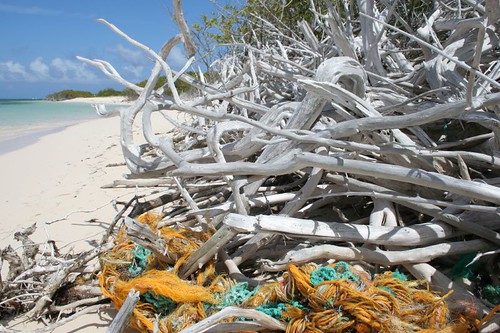 People are always surprised to see all the garbage when the go to one of these remote windward beaches. I have heard many people ask why the locals there leave all the trash.
 Many people think that the garbage was left there by ignorant picnickers, and I have to explain how it all works. Let me try here…: Much of the Atlantic above the equator is like a large connected river. The currents swirl around covering thousands and thousands of miles. This map gives you an excellent guide to help explain what I am speaking about. Keep it open in another window if you like. Ok imagine you are on a yacht off England and France trying to sail into the English Channel. The winds have picked up and your trusty Tilly Hat blows off your head into the sea. There is too much work to do to tack back and retrieve the hat which has accompanied you across the Atlantic from Antigua, so you say goodbye and keep sailing on. The Tilly family made their hats for sailing and from the start had designed these fine hats to be unsinkable by using a bit of foam inside them. The Tilly hat is now flotsam and is starting a long voyage which will take it all the way back to the country of Antigua and Barbuda. The currents carry the hat way offshore France and down past Spain just missing its North Western tip as it meets up with a few wine bottles along the way.
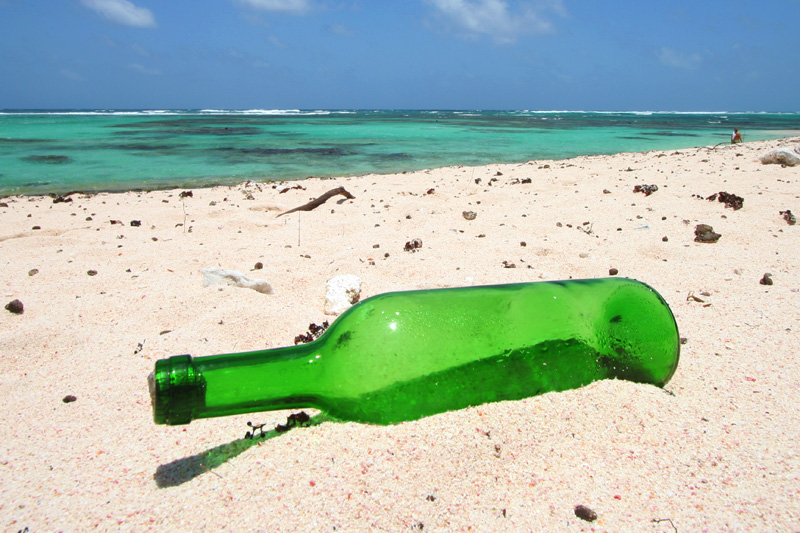 It passes along the coast of Portugal where it bumps into fishing nets, buoys, bottles and other flotsam. It makes the crossing outside the Med on a long voyage well offshore morocco towards the Canary Islands. Bumping into a few pieces of pumice is narrowly escapes floating up onto a busy beach filled with people speaking what sounds like German. Wow that was lucky (just kidding)…..The air starts to get pretty dusty and with all the barnacles and other live stuff trying to attach themselves, it isn’t easy keeping clean. The Tilly is starting to look pretty old and the journey isn’t over yet. Passing offshore the East African coast the weather starts to get much warmer even though the haze makes the sky a bit misty. Tiny fish have started to hide under the hat and every now and then Dolphin Fish bump into it trying to catch them. The barnacles are being chewed off by oceanic trigger fish and the Tilly is now a floating habitat on course to the Caribbean. Ah ahead are some very beautiful islands and for a few days everyone thinks they have arrived in the Caribbean a bit early. Instead up washing ashore the currents make a sharp turn and the Tilly habitat escapes washing ashore on the Cape Verde islands. Beautiful place though. Days turn into weeks without seeing land and apart from a few birds which try to land on the Hat nothing unusual happens. A shark comes by to see if the Tilly is alive and gives it a good bump before slowly disappearing into the deep blue. Six weeks after leaving the Cape Verde Islands the Tilly bumps into a large clump of Sargasso Seaweed which contains a wealth of life and other floating debris. There isn’t much wind or current here and for a week or so the sea of weed seems to trap the Tilly. The winds pick up as some stormy clouds pass and once again the hat is on the move along with a nice wine bottle. The bottle has something in it and upon closer inspection it appears to have a note inside. The bottle floats past and for a week nothing comes near the hat until one afternoon after sunset a long florescent bulb comes drifting past. That night there is a noise in the distance and brightly covered sea monster comes zooming past going the opposite direction. Several days later two heavily bearded men come rowing their boat slowly past the Tilly. They look tired and appear to have had way too much sun. Both the hat and the rowers are on the same course and maybe they will meet up in the Caribbean. It gets very windy again and a very beautiful jellyfish comes sailing very rapidly past the hat trailing a thin carpet of purple and blue tentacles. One of the tiny trigger fish that was hiding under the hat is curious and gets too close. Immediately it is stunned by the tentacles which appear to drag the little fish towards the sailing blue devil.
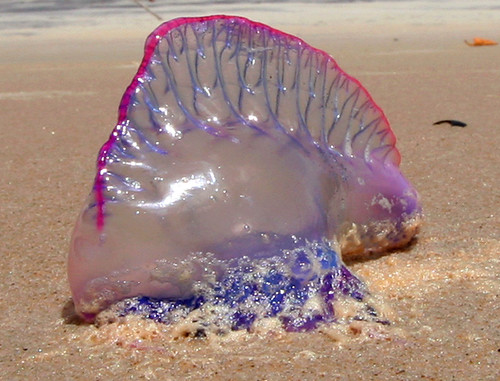 The Portuguese Man of War has captured one from the Tilly habitat. The next day the hat floats by a funny thing: a computer screen covered in barnacles bobs up and down ever so slowly drifting in the currents. You see all sorts in this river of current. You imagine anything at all that can float and that could possibly end up in the sea and it will be there. After about 8 months of drifting and hoping to end up back in Antigua the end is near. The currents have changed a tiny bit and instead of drifting up at Green Island the Tilly makes it to its second most favorite place. It’s a tiny beach at a place called Griffin Point on the East Coast of Barbuda. Most of the fish that were hiding beneath the hat realized something was wrong as the hat tumbled through the breakers on the outer reefs. They decided to swim out past the reef into the currents in order to keep drifting with a beer crate they had seen that morning. The beer crate had more of a habitat anyway, but the Tilly had made it to land at long last. The bright sandy beach was more beautiful than could be described but it was hot. It was super hot, and before long all the barnacles and other life stuck on the hat had been bleached off by the sun. The hat lay there baking every day with only crabs, a few nesting turtles, and several migratory birds passing close by. It wasn’t until a tall lanky guy called Eli passed by that a new permanent home would be found.
  Hahahaha the End? Not really….because I gotta explain what happened to the beer crate. LOL …I won’t do it like i did with the hat, but the currents that pass through the Caribbean islands make their way up to join the extremely strong Gulf Stream which goes along the east coast of the USA all the way up to Canada. All that flotsam that didn't get washed ashore carries on in this river of current. From Canada it leaves and goes back towards England where the beer crate may wash up on a nice beach on Cornwall. Things can and often make their way around the Atlantic more than one time, but any time you walk on a windward facing beach in this long journey you will find garbage that could have entered the sea anywhere along its path. Almost all the soft plastics have bite marks from fish, turtles and other wildlife. Much of the readable containers are written in Portuguese and Spanish, and some of the fishing equipment is extremely primitive suggesting poor countries like those on the west africa. There are long line glow sticks suggesting hard core commercial fishing, and all kinds of other interesting clues as to where the washed up stuff came from. Next time you see something on a beach imagine the travels it’s been on. Its a fun bit of day dreaming.
“Traditionally, flotsam and jetsam are words that describe goods of potential value that have been thrown into the ocean. There is a technical difference between the two: jetsam has been voluntarily cast into the sea (jettisoned) by the crew of a ship, usually in order to lighten it in an emergency; while flotsam describes goods that are floating on the water without having been thrown in deliberately, often after a shipwreck. Traditionally spelled flotsom and jetsom, the "o" was replaced with "a" in the early twentieth century and have since been out of common usage.”
Whenever I walk any beach facing windward I look along the shoreline for jetsam and flotsam as I find the stuff so interesting. I imagine how it fist got into the water and the journey it’s traveled to get there. The best place I have ever seen for the stuff is the east coast of Barbuda which is where I have spent a great many holidays as a kid and now as a “grownup”. Beachcombing is one of the most relaxing things for me and sometimes I am happy to walk for hours and hours looking for shells and washed up bits and pieces. Of course most of the stuff that washes up is total garbage, but so much of it is more than just trash. If you spend time to think about the negative aspects of this garbage it can be quite depressing for many reasons. I mean I have actually freed several turtles from big green nets out in the Atlantic. Of course this is the most obvious way flotsam can harm animals. I am not sure where this thick green net comes from but its drifts up all over the Caribbean from out in the Atlantic. No fishermen here use it, and I am sure that if I did a little research I could find which county’s fishermen use it. Apart from killing turtles, it covers the reefs as it drifts towards the shore. There isn’t a single section of reef on Barbuda’s windward coast that is without this type of net. I have never seen it myself, but did see a report on TV about whales that had become entangled in it.
At the end of the day, anything at all that floats will end up drifting ashore or getting stuck on a reef someday. Beaches that have people living along them or those that have hotels beside them will probably be cleaned, but remote windward beaches will have flotsam and jetsam piling up until they photo degrade or until they are covered in sand.
People are always surprised to see all the garbage when the go to one of these remote windward beaches. I have heard many people ask why the locals there leave all the trash. Many people think that the garbage was left there by ignorant picnickers, and I have to explain how it all works. Let me try here…: Much of the Atlantic above the equator is like a large connected river. The currents swirl around covering thousands and thousands of miles. This map gives you an excellent guide to help explain what I am speaking about. Keep it open in another window if you like. Ok imagine you are on a yacht off England and France trying to sail into the English Channel. The winds have picked up and your trusty Tilly Hat blows off your head into the sea. There is too much work to do to tack back and retrieve the hat which has accompanied you across the Atlantic from Antigua, so you say goodbye and keep sailing on. The Tilly family made their hats for sailing and from the start had designed these fine hats to be unsinkable by using a bit of foam inside them. The Tilly hat is now flotsam and is starting a long voyage which will take it all the way back to the country of Antigua and Barbuda. The currents carry the hat way offshore France and down past Spain just missing its North Western tip as it meets up with a few wine bottles along the way. It passes along the coast of Portugal where it bumps into fishing nets, buoys, bottles and other flotsam. It makes the crossing outside the Med on a long voyage well offshore morocco towards the Canary Islands. Bumping into a few pieces of pumice is narrowly escapes floating up onto a busy beach filled with people speaking what sounds like German. Wow that was lucky (just kidding)…..The air starts to get pretty dusty and with all the barnacles and other live stuff trying to attach themselves, it isn’t easy keeping clean. The Tilly is starting to look pretty old and the journey isn’t over yet. Passing offshore the East African coast the weather starts to get much warmer even though the haze makes the sky a bit misty. Tiny fish have started to hide under the hat and every now and then Dolphin Fish bump into it trying to catch them. The barnacles are being chewed off by oceanic trigger fish and the Tilly is now a floating habitat on course to the Caribbean. Ah ahead are some very beautiful islands and for a few days everyone thinks they have arrived in the Caribbean a bit early. Instead up washing ashore the currents make a sharp turn and the Tilly habitat escapes washing ashore on the Cape Verde islands. Beautiful place though. Days turn into weeks without seeing land and apart from a few birds which try to land on the Hat nothing unusual happens. A shark comes by to see if the Tilly is alive and gives it a good bump before slowly disappearing into the deep blue. Six weeks after leaving the Cape Verde Islands the Tilly bumps into a large clump of Sargasso Seaweed which contains a wealth of life and other floating debris. There isn’t much wind or current here and for a week or so the sea of weed seems to trap the Tilly. The winds pick up as some stormy clouds pass and once again the hat is on the move along with a nice wine bottle. The bottle has something in it and upon closer inspection it appears to have a note inside. The bottle floats past and for a week nothing comes near the hat until one afternoon after sunset a long florescent bulb comes drifting past. That night there is a noise in the distance and brightly covered sea monster comes zooming past going the opposite direction. Several days later two heavily bearded men come rowing their boat slowly past the Tilly. They look tired and appear to have had way too much sun. Both the hat and the rowers are on the same course and maybe they will meet up in the Caribbean. It gets very windy again and a very beautiful jellyfish comes sailing very rapidly past the hat trailing a thin carpet of purple and blue tentacles. One of the tiny trigger fish that was hiding under the hat is curious and gets too close. Immediately it is stunned by the tentacles which appear to drag the little fish towards the sailing blue devil.The Portuguese Man of War has captured one from the Tilly habitat. The next day the hat floats by a funny thing: a computer screen covered in barnacles bobs up and down ever so slowly drifting in the currents. You see all sorts in this river of current. You imagine anything at all that can float and that could possibly end up in the sea and it will be there. After about 8 months of drifting and hoping to end up back in Antigua the end is near. The currents have changed a tiny bit and instead of drifting up at Green Island the Tilly makes it to its second most favorite place. It’s a tiny beach at a place called Griffin Point on the East Coast of Barbuda. Most of the fish that were hiding beneath the hat realized something was wrong as the hat tumbled through the breakers on the outer reefs. They decided to swim out past the reef into the currents in order to keep drifting with a beer crate they had seen that morning. The beer crate had more of a habitat anyway, but the Tilly had made it to land at long last. The bright sandy beach was more beautiful than could be described but it was hot. It was super hot, and before long all the barnacles and other life stuck on the hat had been bleached off by the sun. The hat lay there baking every day with only crabs, a few nesting turtles, and several migratory birds passing close by. It wasn’t until a tall lanky guy called Eli passed by that a new permanent home would be found. Hahahaha the End? Not really….because I gotta explain what happened to the beer crate. LOL …I won’t do it like i did with the hat, but the currents that pass through the Caribbean islands make their way up to join the extremely strong Gulf Stream which goes along the east coast of the USA all the way up to Canada. All that flotsam that didn't get washed ashore carries on in this river of current. From Canada it leaves and goes back towards England where the beer crate may wash up on a nice beach on Cornwall. Things can and often make their way around the Atlantic more than one time, but any time you walk on a windward facing beach in this long journey you will find garbage that could have entered the sea anywhere along its path. Almost all the soft plastics have bite marks from fish, turtles and other wildlife. Much of the readable containers are written in Portuguese and Spanish, and some of the fishing equipment is extremely primitive suggesting poor countries like those on the west africa. There are long line glow sticks suggesting hard core commercial fishing, and all kinds of other interesting clues as to where the washed up stuff came from. Next time you see something on a beach imagine the travels it’s been on. Its a fun bit of day dreaming.


 Yesterday’s match had some episodes of greatness, but for the most part our boys looked slow and uninterested.
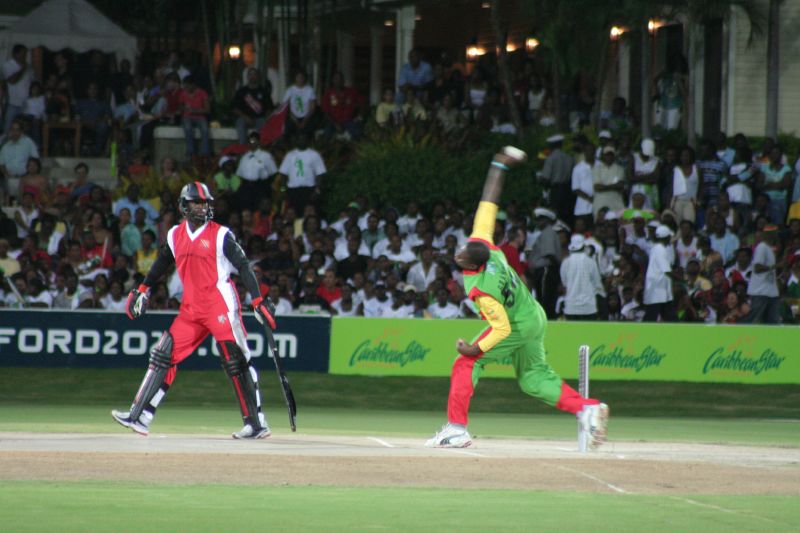
  Although the west Indies side did even worse than when they played the Aussies, I think New Zealand will be no match for the Aussies. Anyway, while we sat there looking at our pathetic run rate, we could only try to salvage some fun from being there. After all, we were sitting on the grass in the party stand on Trevor’s 40th birthday. Seen here with a friendly Trini supporter.
 The pool seemed to be full of a mix of nationalities this time instead of all Aussies like the previous days and boy was it hot. Very little wind and almost uninterrupted sunshine made it feel like there was no ozone over the stadium. Sweat poured off of us and we had to keep making use of the drink tickets that were supplied at the entrance. With your party stand ticket, you got lunch and 9 drinks which should have been soft out there in that heat, but this is cricket in the Caribbean and nobody drinks sodas during a match. Rum and Coke was the patriotic drink of choice for Trevor’s birthday celebrations and we had plenty. Actually Pepsi is the main sponsor so coke wasn’t an option, but they seemed to go down better and better as the chances of winning seemed less and less likely. Towards the end dancing was breaking out all over the party stand and it was like a miniature carnival with the famous chickie hifi belting out some sweet West Indian tunes. There are probably very few teams who’s fans would dance and drink with so much festivity after a dramatic loss, but that is what Caribbean cricket can still cling to. We do want our team to win, but we won’t let their poor showing dampen the mood too much. West Indian captain, Brian Lara, tried to blame his team’s result on the lack of Antiguan support in the grounds, but I think he’s totally wrong. I think his comments today were unfounded and stupid. He’s lucky the fans here didn’t throw stuff at him…..instead they danced after the loss.
 The required run rate kept on getting larger and larger and i knew it would be hard to catch the champs. Lara had some very good 4s and a nice 6...possibly two, but with a LBW at about 77 runs we knew things were not gonna work out. In the end the world champs were victorious and the Viv Richards stadium showed them a good time. Chickie's music kept the vibe up and even the famous Gravy was there to entertain. Here are both of them from yesterday:
 I am off there again right now to see our guys play New Zealand. It's trev's 40th birthday and i hope he gets a good result on it as well.

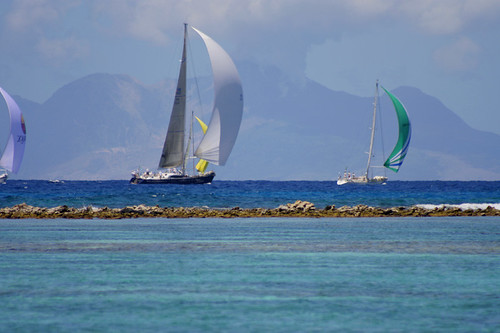
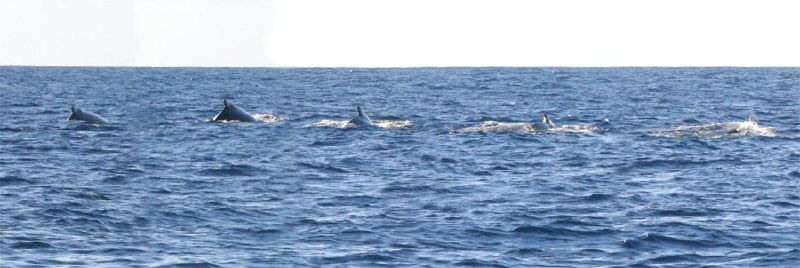

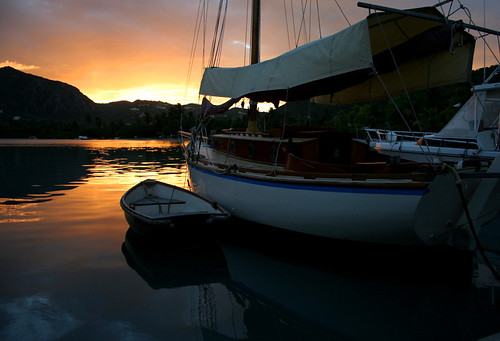 and then Antigua Sailing Week. Its gonna be a very busy Spring this year for the birds, bees, fishies, whales, dolphins, cricketers, sailors, lovers and most others here on the island. Hope you manage to be here enjoying some of it. See you then.
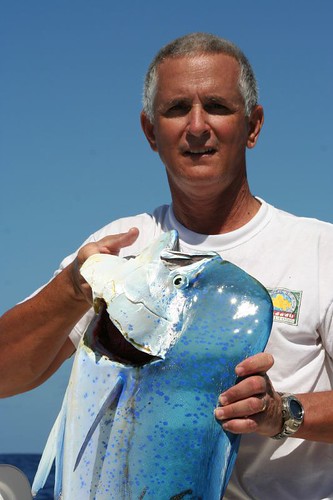
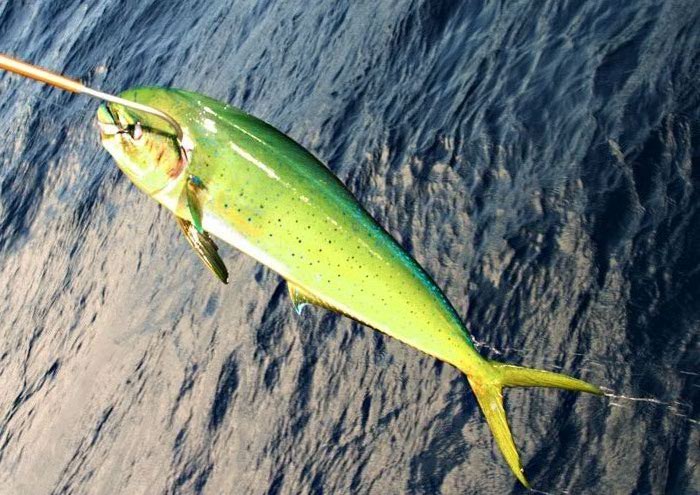 Since they do such a fantastic job of reproducing and grow at such rapid rates, they are one of the few fish sought commercially that doesn’t appear to be threatened by international fishing. It’s a good thing because they are regarded as one of the most delicious and sought after fish too. With new techniques and modern equipment it is common for commercial fishermen to catch up to a thousand pounds of dolphin fish on a good day.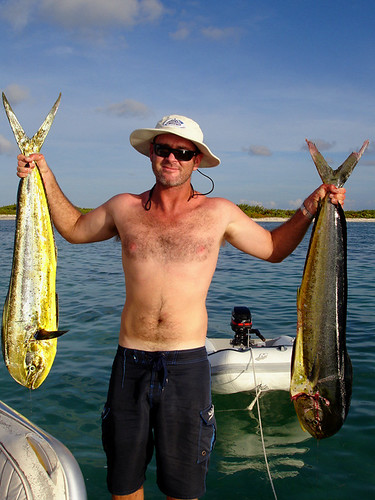

 We took one of his old Jet Ski trailers and turned into the first mobile kitesurfing school on Antigua. IT was fun and people were excited. IT was never run properly as a business because both Alex and myself had other things going on, but we taught many people in those early days. We had hired one of our first students to teach as he had done very well during the learning process. Andre Phillip who is now an international kitesurfing brand almost learned in about 15 seconds one day after I briefly told him how it all worked. He was our first teacher, and KiteAntigua started slowly turning over some business.
 Adam had a pre existing condition that didn’t like the choppy conditions off jabbawock beach and I actually broke my knee in two places after landing badly form a huge jump. Needless to say that neither of us Kitesurf anymore, but we would if we could.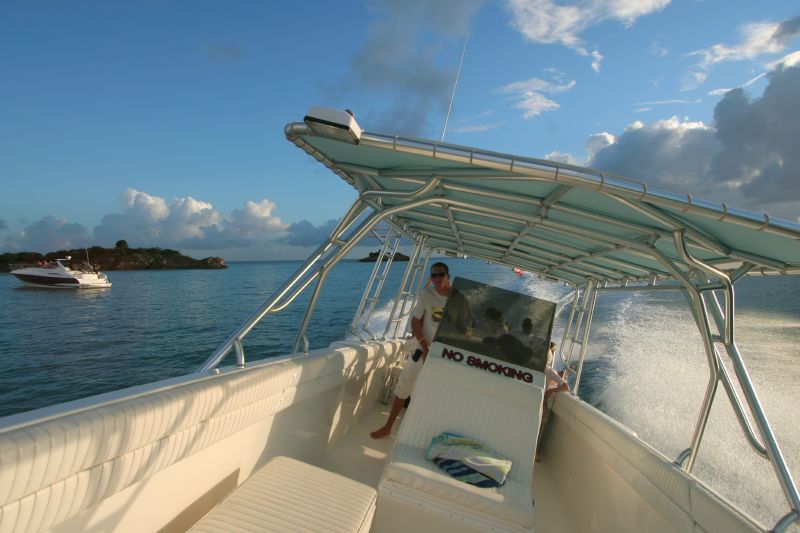




 Check
Check  I am glad i don't have to clean sails! Many of the yachts doing crossings come in with dirty sails and even aircraft have trouble on the leading edges of their equipment.
 They even have